The Origin and True Use of the Giant Odachi Sword: 3-Meter Japanese Super Tachi
Many sword enthusiasts cannot easily distinguish between an Odachi and a Nodachi. Although both represent oversized Japanese swords, they have clear differences in definition, size standard, and usage scenarios. In classical Japanese literature, an Odachi officially refers to a Tachi with a blade length of over 150 centimeters, while a Nodachi is defined as a large field sword with a blade length of 90 centimeters or more. In modern collection and academic classification, Nodachi is no longer simply an alias for Odachi; instead, it is a subcategory derived from the giant Tachi system, specifically referring to oversized Tachi designed for field combat and stored with a complete Saya scabbard.
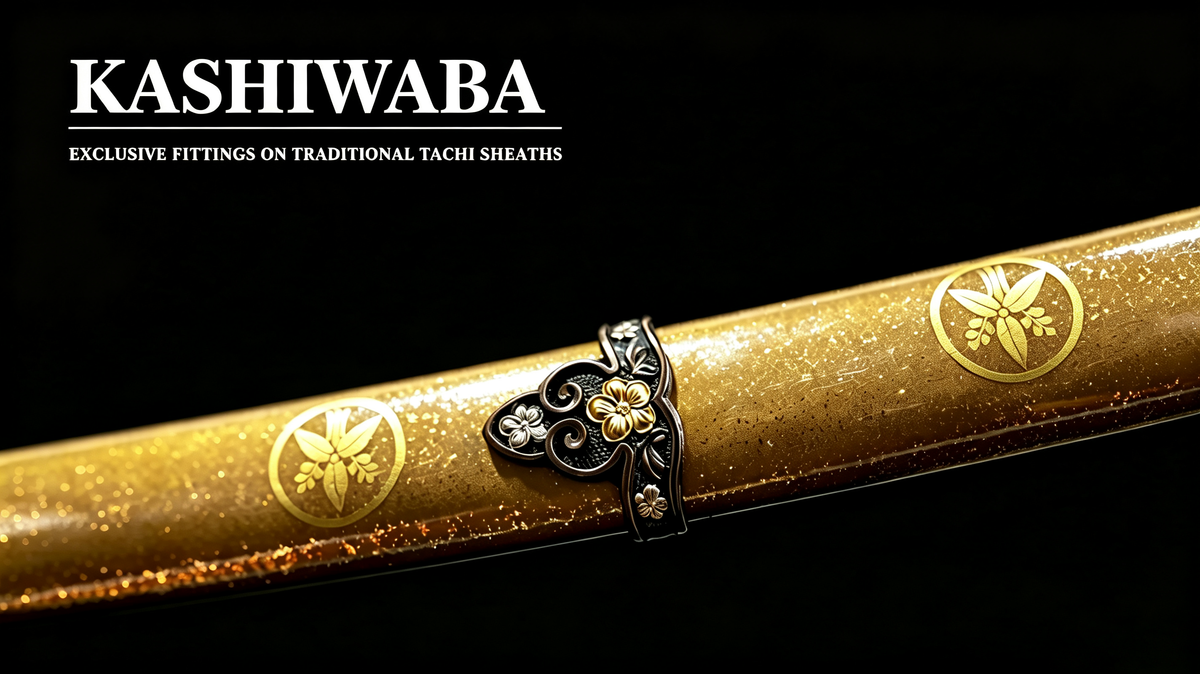
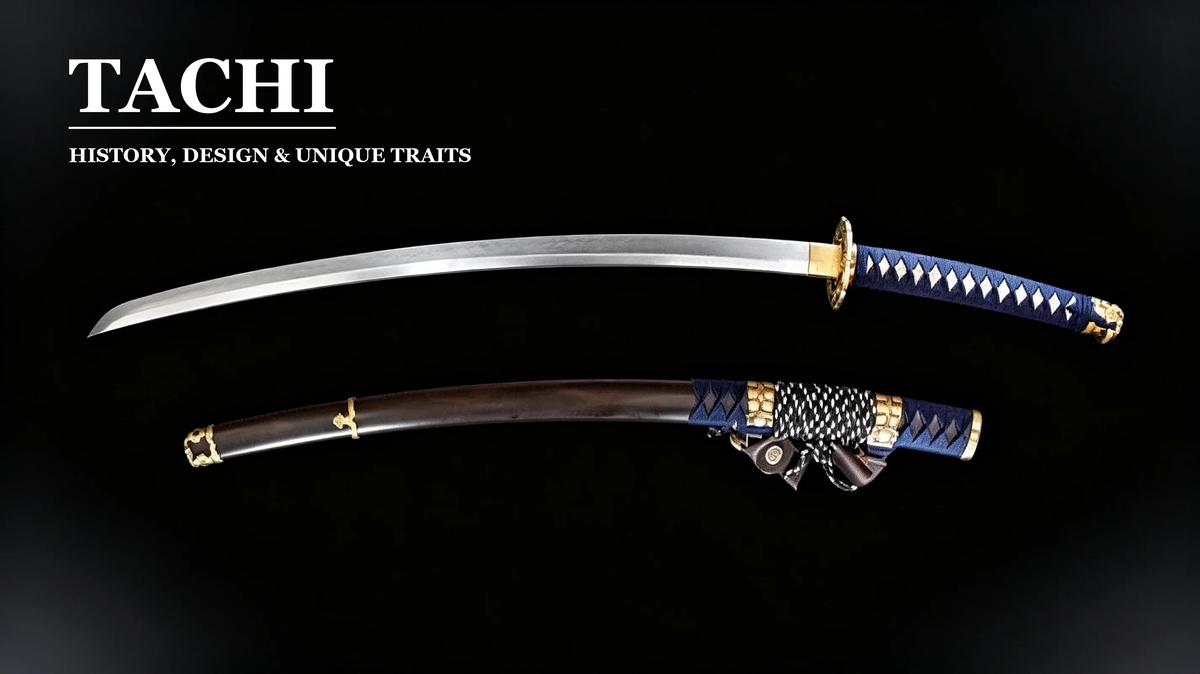
Traditional tachi koshirae and classification standards
When talking about the ultimate giant sword in Japanese sword history, the super-sized Odachi enshrined in Japanese shrines is undoubtedly the most shocking existence. Most conventional weapons follow the logic of “larger size, stronger power”, focusing on brute force rather than delicate sword skills, which granted heavy long swords unique battlefield advantages in ancient cold weapon warfare. However, the super giant Odachi preserved in Futarasan Jinja far exceeds the scope of human combat use. With an extreme total length close to three meters, this incredible sword has become a famous cultural wonder among Nihonto collectors.
The most representative sacred Odachi is the famous cultural treasure Nenekirimaru (祢切丸). This unmarked Odachi boasts a blade length of 2.2 meters and an overall length of 3.4 meters, weighing as heavy as 22.5 kilograms. It is recorded that this legendary sword was forged by the same master craftsman who created the world-famous Mikazuki Munechika. According to local folklore in Japan’s Namchong Mountain area, a mysterious insect demon once haunted the mountain and disturbed local residents. In response, the enshrined Nenekirimaru Odachi flew out of the shrine independently, chased the demon across the mountains, and finally beheaded it in front of Futarasan Jinja, hence obtaining its renowned nickname.


This mythical legend fully reflects the Japanese nation’s profound admiration for giant long swords, a cultural complex that can be traced all the way back to Japan’s mythological era. Ancient Japanese classics record the heroic story of Susanoo defeating Yamata no Orochi. After intoxicating the eight-headed serpent with wine, Susanoo beheaded it with a sacred sword. While cutting through the serpent’s tail, his sword blade broke after hitting an extremely hard object. After dissecting the serpent’s body, he obtained the ultra-sharp Ama no Murakumo no Tsurugi, which later became a sacred treasure used by the legendary ancient hero Yamato Takeru no Mikoto.

It is evident that the worship of giant long swords has been deeply rooted in Japanese culture since ancient times. After Japanese sword forging technology matured in the Kamakura period, craftsmen began to mass-produce enlarged and thickened oversized Tachi, giving birth to the official Odachi weapon system. Many enthusiasts hold a common misconception that Odachi and Nodachi are completely interchangeable, but modern academic classification has corrected this error. The broad modern standard defines any Tachi with a blade length exceeding 90 centimeters as Odachi. Considering that the average height of ancient Japanese people was only 150 to 160 centimeters, such sword sizes were extremely exaggerated and formidable for individual warriors.
Not all Odachi were forged for actual combat. A large number of ultra-large Odachi enshrined in major Japanese shrines serve purely ceremonial and sacrificial purposes, representing the highest specification of Japanese sword craftsmanship and spiritual worship rather than battlefield weapons. Only medium-sized Odachi with blade lengths between 120 and 160 centimeters were truly suitable for samurai battlefield combat.
During the Kamakura era, the samurai family held power, so samurai often chose weapons of huge size to show their strength. At this time, odachi became their favorite.
Core structural differences between tachi and katana
The mainstream battlefield advantage of Odachi lies in its powerful anti-cavalry tactics. In ancient Japanese wars, cavalry charged with spears and long blades, forming an extremely impactful assault formation. Ordinary short swords and even standard Tachi could not block cavalry charges effectively. However, the super-long blade of Odachi allowed samurai to strike down from a high angle, directly cutting off horse legs or slashing cavalry armor gaps, breaking the charge formation in one hit.

However, Odachi also had fatal battlefield flaws. Its tremendous weight and length made it extremely inconvenient for close-quarters rotation and continuous attacks. Once the battle entered dense troop melee, Odachi’s swinging space was severely limited, and samurai were easily restrained by flexible short weapons. Therefore, in actual historical battles, Odachi was mostly used for frontal formation suppression and anti-cavalry interception, rather than mainstream melee weapons.
In addition to battlefield combat, the most intuitive feature of Odachi is its terrifying size. Taking the enshrined Nenekirimaru as an example, ordinary adults cannot even hold the sword steadily with both hands, let alone complete swinging and slashing movements. Most people lack an intuitive concept of the 3-meter-level super long sword, and the size gap between humans and giant Odachi is far beyond imagination.

Many people question whether such an oversized sword can be normally drawn and used. In fact, Odachi has a unique set of drawing and postures completely different from ordinary Katanas and Tachis. Due to its excessive length, Odachi cannot be drawn horizontally while standing like ordinary swords. Ancient samurai and modern Odachi practitioners both adopt the method of drawing the sword by lifting the hilt vertically, or holding the blade upward to complete separation from the scabbard.
In actual combat and practice, Odachi is mostly carried on the back, with the blade facing upward. When fighting, the samurai first leans forward to lower the center of gravity, then pulls the hilt upward to draw the sword, and uses the weight of the long blade to complete a powerful vertical slash. This set of movements focuses on one-strike killing, abandoning the flexible consecutive strikes of ordinary Japanese swords, and belonging to the typical heavy weapon crushing combat style.

Nowadays, the real combat scenario of Odachi has completely disappeared with the end of cold weapon warfare, but the forging craftsmanship and cultural connotation of giant Odachi have been completely inherited. As a special category of Nihonto, oversized Odachi represents the ultimate pursuit of Japanese sword forging in length, weight, and momentum, and is an indispensable important part of Japanese traditional sword culture.
For more authoritative identification and cultural inheritance of traditional Japanese swords

Leave a comment
This site is protected by hCaptcha and the hCaptcha Privacy Policy and Terms of Service apply.