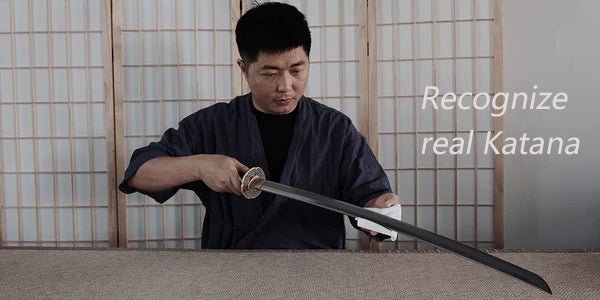
Katana's Buying Guide: Complete Tips for All Types of Buyers

Japanese samurai katanas circulating on the market vary wildly in material, craftsmanship, pricing and practical performance, and most novice buyers will fall into various hidden traps without systematic reference. Many selection guides only talk about superficial parameters such as steel and appearance, while ignoring a great deal of unpopular but critical professional knowledge that directly determines the service life, safety and collection value of the blade. Before you place an order for your first katana, you must first clarify your core usage scenario, then disassemble the hidden cost composition of the sword, master the discrimination methods of fake craftsmanship, and understand the supporting matching rules of traditional samurai daisho sets. If you want to learn more professional appraisal standards for Japanese blades from authoritative professional institutions, you can browse the professional sword identification archives released by professional Japanese sword dealers via Japanese traditional nihonto appraisal and buying archives.
A little-known fact that 90% of novice collectors ignore: Most online products labeled "authentic Japanese nihonto" are modern industrial replicas, and genuine antique Japanese swords forged with traditional tamahagane steel require official NBTHK certification papers to prove their authenticity, with a starting price far exceeding the budget of ordinary hobbyists. Most civilian buyers focus on high-quality functional replicas, and this guide will focus on the selection logic of replica katanas while supplementing collection identification cold knowledge for advanced enthusiasts.
1. Confirm Your Core Usage Purpose — Different Scenarios Have Exclusive Selection Standards
The biggest mistake most buyers make is buying a katana before confirming their usage needs, resulting in mismatched blade performance, hidden safety hazards or wasted budget. We divide mainstream demand into five categories, and supplement rare hidden selection details that few guides mention:
1.1 Iaido Martial Arts Practice (Beginners & Long-term Dojo Training)
For newcomers who have just contacted sword drawing kata training, professional iaido training swords are called iaito, which are completely different from sharp cutting shinken swords. A cold knowledge easily overlooked: Standard Japanese iaito is made of non-ferrous zinc-aluminum alloy by law, which cannot be sharpened at all, effectively avoiding accidental scratches during repetitive drawing and sheathing practice. Many merchants sell carbon steel blunt swords under the name of iaito; such blades cannot be used for formal dojo training, because repeated friction between steel blade and saya will scratch the inner lacquer of the scabbard in a short time.
If you have practiced iaido for more than one year and need customized parameters, you must provide your arm length, shoulder width and daily training frequency to the craftsman. Professional makers will adjust the blade nagasa and balance point: Iaido swords need a balance point closer to the tsuba to reduce wrist load during hundreds of repetitive drawing movements every day, which is completely opposite to the balance design of tameshigiri cutting swords.

1.2 Tameshigiri Cutting Practice (Bamboo, Tatami Mat, Grass Roll Cutting)
If your core demand is to experience smooth cutting feedback, you need to select a clay-tempered shinken sharp blade, and many people do not know the difference between through-hardening and differential clay tempering. Through-hardened blades have uniform hardness throughout the whole body without natural wavy hamon, low cost, but the edge is easy to bend after multiple cuts; clay differential tempering forms a hard cutting edge of 58-62 HRC and a flexible soft spine, which can absorb impact force during cutting and avoid blade cracking.
Another unpopular tip: Do not blindly pursue ultra-high hardness above 63 HRC for cutting blades. Excessively hard steel will become brittle, and tiny edge nicks will expand into cracks after hitting hard targets such as bamboo nodes. For daily household cutting practice, 1060 or T10 clay-tempered steel is the most cost-effective choice, and the sharpening angle of 15-18 degrees is the standard configuration for tameshigiri swords.

1.3 Collection & Ornamental Display
Collectors can be divided into three niche groups with completely different selection logic, which is rarely distinguished in ordinary buying guides: First, texture collectors who focus on blade hada grain; second, fittings collectors who independently collect tsuba, fuchi and kashira; third, full-set integrated collectors who pursue unified koshirae style.
Cold knowledge for display collectors: The value of complete matching koshirae (the whole set of sword fittings) can even double the value of the blade itself. If the tsuba, menuki, saya lacquer and tsuka ito of a set of swords are designed as a unified theme, its display and collection appreciation will be far higher than a blade with random mixed accessories. Many novice collectors only pay attention to the blade pattern and ignore the matching degree of fittings, resulting in the whole set lacking a sense of coordination when placed on the sword stand.
For high-end collection-grade replicas, you need to distinguish real folded steel hada and acid-etched fake grain: Real layered forging grain has subtle concave-convex texture that can be touched by nails, while acid-etched patterns only stay on the blade surface without any texture fluctuation, and the lines are too neat and rigid without natural organic changes.
1.4 Anime & Movie Cosplay Prop Use
Cosplay buyers only need to focus on the restoration degree of appearance and cost performance, and there is no need to pursue full-tang functional steel blades. Lightweight aluminum alloy or wooden props are the best choice for offline activities, which can meet the venue safety regulations and avoid the trouble of security inspection for metal sharp weapons. A common pitfall: Many cosplayers buy high-carbon steel sharp blades for shooting, but cross-border transportation and local public place carrying of sharp swords will violate local laws and regulations, leading to confiscation of goods or fines.
1.5 Antique Nihonto Investment Collection (Advanced Enthusiasts)
This is a niche category that most entry guides do not cover. Genuine antique Japanese swords (nihonto) cannot be judged only by age. A widespread misconception is that the older the sword, the higher the value; in fact, the five core evaluation criteria of professional appraisers are smith attribution, blade integrity, koshirae matching, NBTHK certification documents and historical inheritance, and age only accounts for less than 15% of the value weight. Uncertified antique blades with severe rust and blade shortening (o-suriage) are even less valuable than well-preserved modern handmade replicas.
2. Hidden Cost Architecture of Katana — Most Buyers Ignore These Extra Expenses
The price marked on the product page is only the basic cost of the sword itself. There are many hidden additional expenditures in the whole purchase cycle, which we sort out in detail with unpopular professional information:
First, material and manual production cost is the core premium part. The same specification of steel blank, the price difference between mass machine processing and all-hand folding forging can reach 3-5 times. The labor cost of clay tempering, blade polishing and hand-wound tsuka ito accounts for more than 60% of the total production cost of high-quality swords, which is also the fundamental reason for the huge price gap of products with the same steel label on the market.
Second, post-purchase necessary supporting costs: Traditional sword maintenance kits (choji oil, wiping cloth, rice paper), solid wood sword display stands, moisture-proof storage boxes are essential supporting supplies, and long-term collection also needs customized anti-rust storage cabinets for humid areas. Cross-border buyers need to calculate international freight, commodity insurance, import customs duties and inspection fees; auction channels also have an additional 20%-30% buyer premium, which is a hidden expense that many people do not include in the budget in advance.
Third, later maintenance and renovation cost: The tsuka ito wrapping will loosen after long-term use, and the saya inner lacquer will wear; professional rewrapping and lacquer repair require additional labor fees. High-end folded steel blades need regular professional polishing every 3-5 years to avoid rust erosion of the layered grain, and the polishing cost is not low.
3. Core Blade Material & Safety Standard — Full Tang vs Rat-Tail Tang
Different steel grades correspond to completely different usage scenarios, and we sort out the hidden advantages and disadvantages of each material that merchants rarely take the initiative to explain:
- Stainless steel: Only suitable for cheap cosplay decorations, the internal carbon content is extremely low, cannot be quenched to form hamon, and the blade is easy to bend when slightly stressed, absolutely not for cutting or training;
- 1045 medium high carbon steel: Entry-level functional material, balanced toughness and hardness, low price, slight rust resistance defect, suitable for beginner daily training;
- 1060 high carbon steel: The mainstream cost-effective choice for replica katanas, stable comprehensive performance, can realize clay tempering hamon, suitable for most cutting and collection scenarios;
- T10 tool steel: High hardness, long edge retention time, but brittle; improper cutting force will cause edge collapse, recommended for experienced tameshigiri practitioners;
- 9260 spring steel: Dedicated iaido training steel, good flexibility, not easy to deform after repeated drawing, less wear to the scabbard;
- Traditional folded tamahagane steel: High-end collection exclusive material, natural layered hada grain, complex forging process, high price, mainly for display and appreciation, not recommended for frequent cutting practice.
The most critical safety standard that cannot be ignored is the tang structure, which is related to personal safety during use: Full tang means that the whole steel of the blade extends to the end of the tsuka handle, fixed by bamboo mekugi pegs, and will not break away from the handle during swinging; rat-tail tang is a thin iron rod welded to the bottom of the blade, only glued into the handle, and it is extremely easy to break and fly out during force use, which is a hidden danger of serious injury.
A discrimination trick rarely shared: Ask the merchant to provide unassembled nakago tang photos before purchasing; regular functional swords will clearly show the integrated steel tang, while inferior decorative swords will refuse to provide detailed tang pictures for various excuses.

4. Budget Tiered Selection Guide for Different Demand Groups
Combined with the hidden cost components sorted above, we divide the product budget into three intervals, and match the corresponding configuration and applicable crowd, avoiding overspending or buying inferior products due to blind pursuit of low prices:
Low Budget (Under $250): Entry-level Decorative & Beginner Iaido Training
Mainly 1045 steel plain blade, through-hardened without natural hamon, simple unified lacquer saya, basic alloy tsuba fittings, standard non-customized length and balance. Suitable for buyers who only use it for wall display or novice iaido entry training, no cutting function support. Do not expect folded grain or hand-carved fittings within this budget; all products labeled "damascus folded steel" below $150 are basically acid-etched fake grain.
Medium Budget ($250-$800): Mainstream Cutting & Daily Collection
1060 / T10 clay differential tempering blade with natural hand-forged hamon, real layered folded hada optional, hand-wound silk tsuka ito, carved metal tsuba matching the scabbard theme, complete full tang safety structure. Support personalized customization of blade length, balance point and fitting patterns, the most popular choice for tameshigiri cutting enthusiasts and mainstream sword collectors.
High Budget (Above $800): High-end Matching Daisho & Texture Collection
Hand-folded multi-layer tamahagane replica blades, fine hand polishing, retro Edo-style complete koshirae fittings, customizable horimono blade carving, matched wakizashi short sword can be made into a complete daisho set. Every detail of the blade and fittings is manually processed, with high collection and display value, suitable for enthusiasts who pursue historical restoration and complete set matching.
5. Most Common Online Buying Misconceptions & Fake Identification Cold Knowledge
After sorting out a large number of buyer feedback, we summarize several misunderstandings that almost all novices will step into, and attach simple and effective identification methods:
- Misconception 1: The more layers of folded steel, the better the performance. In fact, excessive folding will reduce the carbon content of the steel and weaken the cutting performance; 8-16 layers of folding are the most balanced for functional swords, and multi-layer folding is only for ornamental texture display;
- Misconception 2: Swords with certificates are authentic high-quality products. Most certificates attached to replica swords are self-made by merchants without authoritative recognition; real professional certification papers such as NBTHK are only used for antique nihonto, and cannot be used as a quality guarantee for modern replicas;
- Misconception 3: All blades with wavy lines on the surface are clay-tempered hamon. A large number of merchants use acid etching to print fake hamon; the fake lines are uniform and shallow, while real clay tempering hamon has irregular natural fluctuations and internal depth changes of the blade metal;
- Misconception 4: "Battle-ready" marked swords can cut any hard object. This label is just a marketing slogan; the actual cutting limit depends on steel hardness and blade thickness, and even high-quality shinken will crack when hitting hard metal or stone;
- Misconception 5: After buying, you can store the blade casually. High-carbon steel blades are easy to rust, and fingerprints left on the blade surface will form permanent rust spots after a week if not wiped and oiled, which cannot be repaired by polishing.
6. Cross-Border Legal & Shipping Compliance Notes
The laws and regulations controlling edged weapons vary greatly in different countries and regions, which is a problem that many buyers ignore before placing orders. Most regions divide swords into three categories: unsharpened alloy training swords, functional sharp carbon steel swords and antique collectible nihonto, with completely different registration and carrying rules.
When shipping across borders, sharp blades need to be declared as collectible handicrafts, and the merchant must use professional shockproof wooden packaging to avoid customs detention. It is forbidden to carry sharp katana in public transportation, offline shopping malls and event venues in most regions; cosplay alloy blunt props are allowed to be carried only after confirming the activity venue safety rules in advance. After receiving the goods, you need to keep the product packaging and purchase vouchers for customs inspection and after-sales rights protection.
7. Match Daisho Set — Pair Katana With Wakizashi For Authentic Samurai Display
The daisho matching system of one long katana and one short wakizashi is the core symbol of Edo-period samurai identity, and many collectors only buy a single katana and ignore the supporting short sword matching rules. Traditional daisho sets require unified style coordination: the tsuba, fuchi, tsuka ito material and saya lacquer pattern of katana and wakizashi must be designed as a matching group, and the curvature of the two blades needs to maintain a unified radian proportion to restore the historical wearing effect.
If you want to know the complete historical knowledge, size classification and combat application of samurai short swords, you can read our special in-depth tutorial: Wakizashi short sword full historical & collection guide. If you want to browse matching daisho combination products, you can check our full range of samurai sword series: Browse all functional and display katana collections.

8. Post-Purchase Basic Appreciation & Long-Term Maintenance Tips
The purchase of katana is not the end; long-term proper maintenance determines the blade's service life and collection value, and many maintenance cold knowledge is not popularized in product introduction pages. After each contact with the blade, use special sword wiping rice paper to wipe off skin oil and sweat stains from the spine to the cutting edge, and evenly apply a thin layer of choji anti-rust oil; do not use household engine oil or skin care oil instead, which will corrode the blade metal over time.
In humid coastal areas, it is necessary to take out the blade from the saya every two weeks for ventilation and oil replenishment, and place a moisture-proof dehumidification bag in the sword storage cabinet. Avoid long-term placement under direct sunlight, which will cause the saya lacquer to crack and the tsuka stingray skin to harden and fall off. For systematic and comprehensive maintenance operation steps, you can view our exclusive appreciation and care column: Complete katana appreciation and long-term maintenance tutorial.
Katana For Sale: Customized Samurai Swords For All Buyers
We provide full-series replica katanas covering entry training, tameshigiri cutting, home display, anime cosplay and complete daisho matching sets. All functional blades adopt standard full tang safety structure, support personalized customization of blade length, balance point, carving patterns and full set of koshirae fittings, and each product is equipped with detailed steel parameter and production process description to avoid buyers stepping into fake craftsmanship traps. Whether you are a beginner buying your first sword or a senior collector pursuing complete daisho matching, you can find a katana that matches your budget and usage needs in our collection series.
Safety Warning: All katana replicas default to sharpened edges. Customers can choose blunt or sharp blades at checkout. These swords are only for anime cosplay, desktop display and collection. Please handle metal blades with caution, avoid reckless swinging, stabbing or dangerous gestures to protect personal safety.